An independent travel journal — go when the country is at its best.
Questions, corrections, story notes
Two days is enough,
if you spend them
like two days.
A short break is not a compressed long trip. It is a different shape: one city, one base, two or three decisions made early, and enough unclaimed time left over that the place gets a chance to surprise you.
Cities and Short Breaks is the standing guide to capital cities and the two- to three-day escape — orienting yourself in the first two hours, choosing a neighbourhood to sleep in, reading a transport network without studying it, weather-proofing a window too short to wait out rain, and giving the last day to the region immediately outside the city limits.
ON THIS PAGE
When two days beat two weeks.
Long trips carry a hidden tax: distance eats days. A fortnight spread across four regions can return less than a weekend spent entirely inside one, because half of it is spent moving between places you are only half awake in. A short break has no travel days to lose — you arrive already inside the thing you came for.
It also handles bad weather better than most people expect. A city keeps working in the rain; a coastal week does not. What a short window cannot absorb is indecision. Three days will not forgive a forty-minute argument about where to eat, so the decisions worth making are the ones you make before you leave.
CHOOSE THE SHORT WINDOW WHEN
The season is unsettled and you want somewhere that works indoors as readily as out.
You are testing a region before committing a longer trip and a bigger budget to it.
The group shares one clear day off rather than a clear week.
The journey there is short enough to be forgotten by lunchtime on day one.
What you actually want is rest, not coverage.
The first two hours
decide the other
seventy.
An unfamiliar city is not confusing because it is complicated. It is confusing because you have no fixed points yet. Four small moves, made on arrival, replace an entire afternoon of drifting — and none of them involve seeing anything.
Walk one line out and back
Pick a single street from where you are sleeping and follow it for twenty minutes, then return the same way. One line teaches you more about scale, noise and where the city thins out than a loop of landmarks ever will.
Fix north to something tall
Choose one visible anchor — a river, a ridge, a tower, the water — and orient everything to it. Australian capitals nearly all have a coast or a range on one side, so a single glance can replace a map for the rest of the trip.
Settle the transport question once
Sort the ticket or travel card in the first hour, at the airport or the first station, while you still have patience for it. Working out fares at nine on a wet evening is the classic way to lose the mood of a short trip.
Leave the first evening deliberately empty
The strongest hours of a short break are usually the unplanned ones on the first night, when you are still reading the place rather than working through a list. Hold the plan for day two and give the first evening to whatever is within walking distance of the door. The full three-day shape is set out in How to Structure Three Days in a City.
One base, chosen for
what it is near.
In a two- or three-day window, moving accommodation once costs roughly half a day in packing, checking out, carrying and waiting. Choose a single neighbourhood and accept its compromises. The right one is rarely the prettiest name on the map — it is the one that keeps your walking short and your late return easy.
What a base actually has to do
Three things, in order: put you within walking distance of one area you want to spend real time in, sit on a line that runs late, and offer somewhere to eat within a few minutes of arriving tired. Anything beyond that is a bonus, not a criterion.
Centre, inner suburb or interchange
A central base buys walking and costs quiet. An inner suburb a few stops out usually buys quiet, better everyday eating and a shorter distance to ordinary city life — provided the connection is frequent rather than merely existent. A base beside a major interchange is the compromise that works when your days pull in different directions.
Test it against the last trip home
Before settling on an area, picture the walk back to it at eleven at night in the weather that month actually delivers. If that walk feels long, dark or dependent on a service that has stopped running, move the base rather than the plan. Solo, family and group versions of this test differ; both are worked through in Travel Styles: Solo, Family, Group.
Reading a network
at a glance.
You do not need to learn a transport system. You need the two or three lines that touch your base, and the difference between a service running every few minutes and one running a few times an hour. That single distinction decides how loosely you can plan a day.
Trams and buses reward short hops and teach you the street layout; trains reward distance and skip everything in between. Ferries, where a city has them, are usually the cheapest sightseeing available and often the fastest way across water. Walking stays the default: most Australian city centres are crossable on foot in under half an hour, and almost everything worth slowing down for happens at walking speed.
Driving inside a capital is the one choice that rarely pays over a short window — parking, one-way systems and clearway hours cost more attention than the car saves. Keep the vehicle for the day you leave the city, if you take one at all.
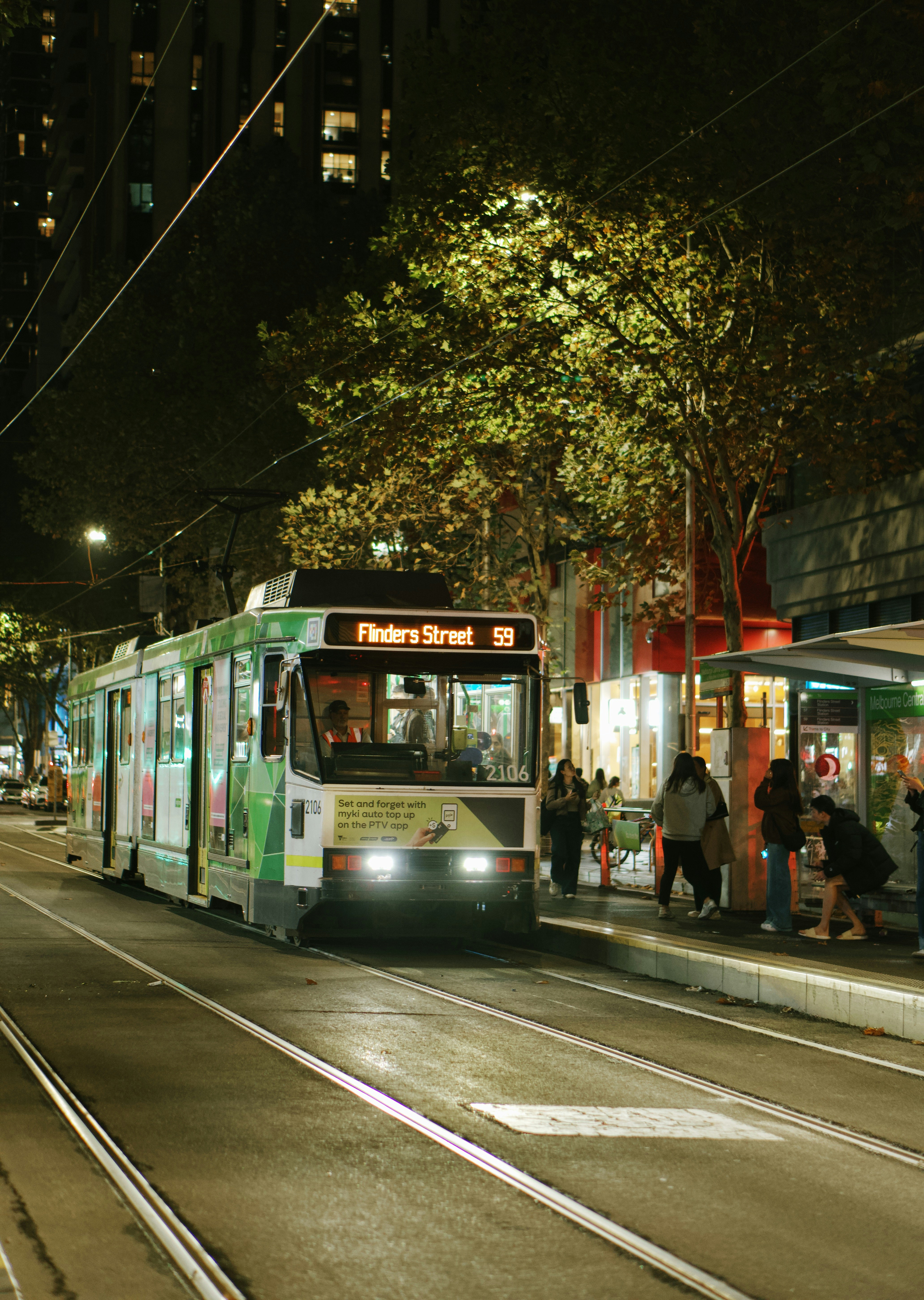
A capital-city tram line after dark. The two or three services that touch your base are the only part of the network worth learning in a two-day window.
Three days cannot
wait out the rain.
On a long trip a wet day is a rest day. On a short break it is a third of the trip, so the fix is structural rather than optimistic: hold one indoor half-day in reserve and let the weather decide which day it lands on. Galleries, markets, libraries, cinemas and long lunches all keep their character in bad light.
Reverse the same logic for heat. In summer the sensible city day runs early and late with a flat, shaded middle — the hours between eleven and three belong to interiors, water or a nap, not to walking a list. In the cooler months the constraint is daylight rather than temperature: put the outdoor part before the light goes and the eating after it.
Pack for one variable day rather than three fixed ones. Packing for Changeable Weather covers the layering, and When to Go: Seasons and Timing explains how the windows differ by region.
Give the last day to
what surrounds the city.
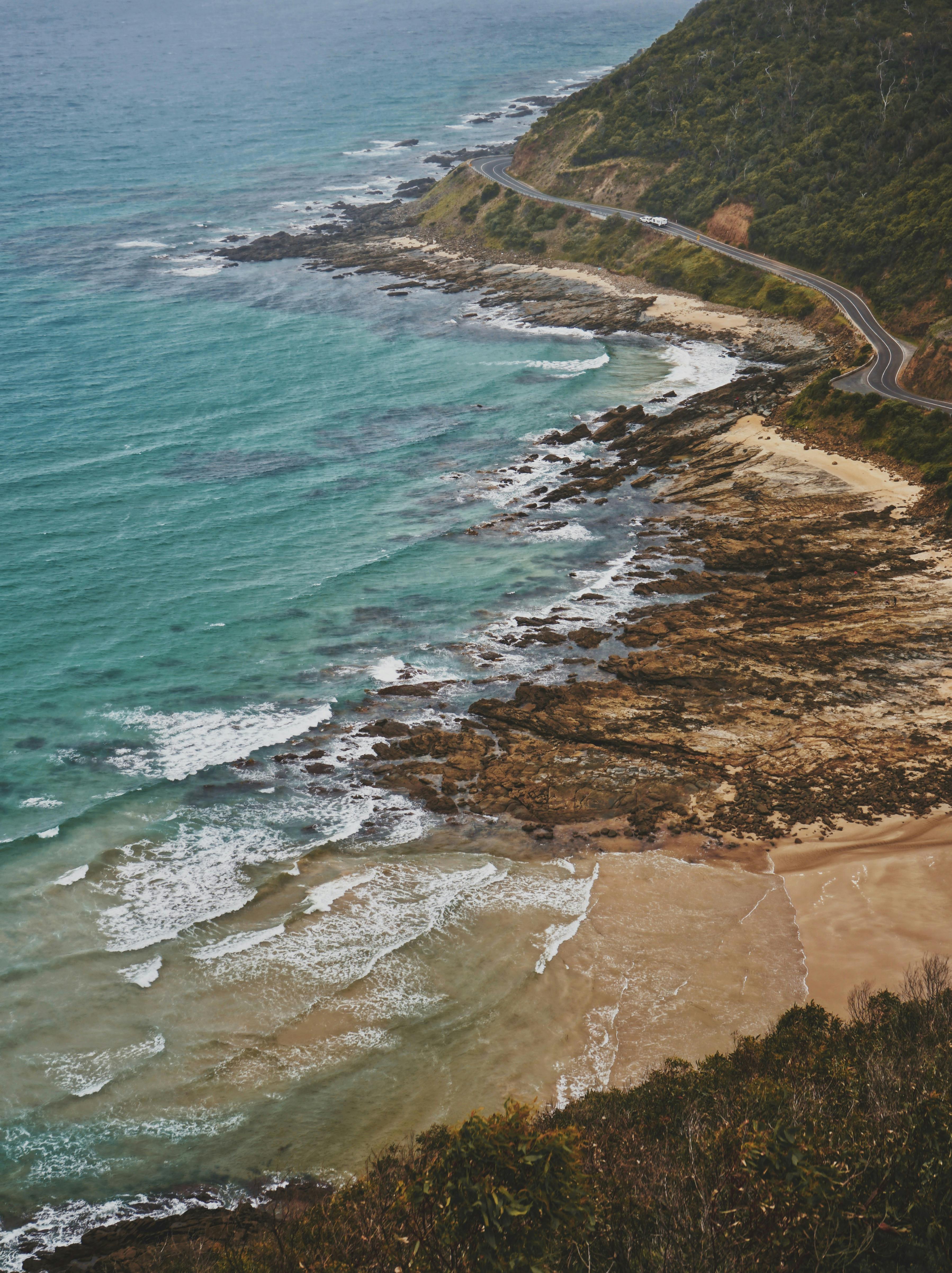
Every Australian capital sits an hour or so from something the city itself cannot offer: a range, a wine district, a bay, a stretch of bush, a peninsula. Pairing two city days with one day out is usually the strongest use of a short window, because the contrast is what you keep — and because the return leg is short enough that a slow start does not ruin it.
The rule is one destination, not a circuit. Pick a single place, allow at least twice as long there as the travel takes, and be back before the light goes. If the day out needs a pre-dawn start and a long haul, it is not a day out — it is the beginning of a road trip, and it deserves its own window.
A coast road winding above shallow turquoise water on the edge of the city’s region — the single destination a last day is usually best spent on.
Regional context for the pairing: Travelling in Victoria · Travelling in New South Wales · Travelling in Tasmania · Travelling in South Australia · Regions We Cover
Where a short break
leads next.
Two days answered one question. The pages beside this one answer whatever the window opens up: the hour-by-hour shape, the cost of a compressed trip, and the country that starts where the tram line ends.
If this guide skipped the city you had in mind, or a network has changed since we wrote it, tell the editors which line.
THE SHAPE OF THE DAYS
How to Structure Three Days in a City — three anchors and one deliberately empty afternoon.
Trip Planning Basics — turning a loose idea into an outline that survives contact with a timetable.
COST, CROWDS AND KIT
Budgeting a Trip — how a two-night window changes the arithmetic.
Planning Around School Holidays — the weekends a city stops being quick.
Packing and Preparation — one bag for a variable day rather than three fixed ones.
WHEN THE CITY IS ONLY THE START
Australian Road Trips — for the day out that wants to become a week.
Coast and Reef — the water at the other end of most capital-city pairings.
Regions We Cover — the region each capital sits inside.