An independent travel journal — go when the country is at its best.
Questions, corrections, story notes
Published September 2026
One coast, five climates,
and every pace
you could want.

Turquoise shallows between forested headlands — the coastal spine repeats this shape for most of the state’s length.
New South Wales is the state most Australian trips pass through and the one most readers under-read. The coastal spine runs for well over a thousand kilometres of beach towns, headlands and river mouths. An escarpment stands an hour behind it. Beyond that the tablelands rise into genuine cold-climate country, the vineyards and inland rivers spread out across flat driving, and the map keeps drying until the far west behaves like the interior in everything but name.
That range is why one state can serve a two-day escape from a capital city and a three-week touring route without either feeling like a compromise. This page sets out how the five bands differ, when coastal pressure peaks, what winter does to the high country, and which of our standing guides to read alongside it. No accommodation or operator listings — this is orientation for planning your own trip.
Five bands, west from the sea
01 · The coastal spine
Far south coast to the northern rivers: surf towns, estuaries and headland walks strung along a highway that never strays far from the water. Short hops, easy driving, warm swimming for much of the year — and the highest holiday pressure anywhere in the state.
02 · The escarpment
Sandstone, gorge country and rainforest gullies sitting an hour or so behind the biggest coastal cities. Altitude does the work here: lookouts that clear or cloud within minutes, cold nights in every month, and weather that rarely matches the beach you left that morning.
03 · Tablelands and high country
From the southern highlands up through the central west to New England, and south again to the alpine range. Cold-climate towns, deciduous autumn colour, frost mornings and the mainland east’s only dependable snow season. Distances stay modest; the temperature swing does not.
04 · Wine and river country
Vine-growing valleys near the coast and the big inland river systems further west. Flat, fast, unhurried driving with towns spaced an hour or two apart, long summer light, and an autumn that most readers find more comfortable than the vintage-season crowds.
05 · The far west
Past the western rivers the map empties out. Red soil, mining and pastoral towns, dry lake systems and horizons that take a day to cross. Fuel and services thin, summer heat sets the calendar instead of your itinerary, and the planning rules shift from coastal to inland.
HOW THE BANDS ADD UP
Crossing from the sea to the far west is a change of country, not a change of scenery. Expect the driving day to lengthen the further inland you go, and expect the gap between towns to grow faster than the kilometres suggest.
A useful rule for a first visit: pick two adjacent bands, not four. The coast plus the escarpment, or the tablelands plus the river country, gives you contrast without spending the trip behind the wheel.
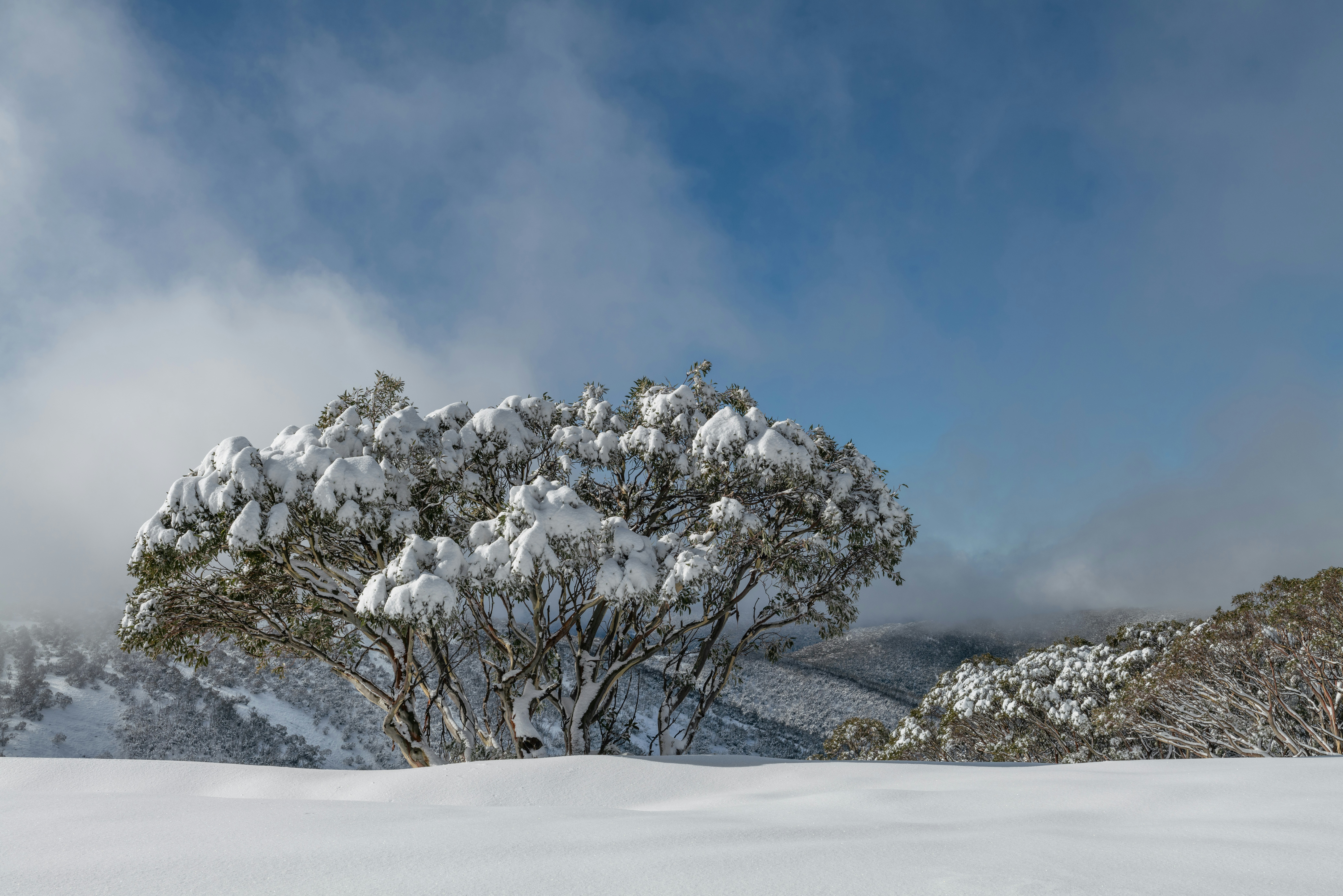
The high country holds winter long after the coast has warmed.
The high country keeps its own winter
The alpine range in the state’s south is the one part of New South Wales that reverses the national rhythm. Its busy season is the cold one, its quiet months are the warm ones, and its roads ask for wheel chains, full fuel and an early start long after the coast has forgotten what a cold morning feels like.
Come summer the same country turns into walking terrain — alpine wildflowers, long daylight, cool nights under canvas — and the towns that serve the snow season empty out. Either version works. What does not work is arriving in one season expecting the other, which is the easiest mistake to make here precisely because nothing else in the state runs on this calendar.
Short break or long tour
Almost every band in the state has an edge within two or three hours of a capital city, and the same five bands will string end to end for a fortnight. New South Wales answers to both, and the two plans are built in opposite directions: a short break narrows until one base is left, a long route widens until the inland sections set the pace of everything else.
Short breaks that start at the city edge
A harbour-city weekend with one day of escarpment lookouts behind it. Beach towns close enough to reach after work on a Friday. A vine valley used as a slow two-night base rather than a day trip. A cold-climate town in autumn, when the colour and the empty streets arrive together.
The discipline is the same in all of them: one base, two decisions, and enough unclaimed hours for the place to surprise you. Adding a second town over a weekend usually costs more than it returns.
Touring routes that cross the grain
The longer routes here read better east–west than north–south: coast in short daily hops, then a turn inland over the range for the return leg, or river country followed downstream at about two hours a day.
Plan the inland stretches first — fuel range, heat window, spare time — and let the coastal legs fill in around them.
When the coast fills up
Coastal New South Wales is where the state’s holiday demand concentrates, and it concentrates on a calendar you can read in advance. The pattern below is about feel — how full a beach town gets, how early you need to decide, how much of the day you spend queuing rather than swimming — not about any fixed availability.
Summer school holidays and the busiest stretch of the coastal year. Long daylight, warm water, crowded headlands and towns running at their limit. Best used if the beach itself is the point and you are content to stay put in one place.
The strongest all-round month in much of the state. Water still swimmable on the north coast, autumn colour in the tablelands, mild driving weather inland. Watch for the autumn school break and the Easter long weekend, which briefly reload the coast.
The inversion month. Alpine towns are at their peak while the coast is at its quietest, and the far west becomes comfortable for the first time since autumn. Cold nights everywhere inland, including places that felt mild at midday.
Spring shoulder: warming coast without summer numbers, wildflowers in the high country, and a workable window for the west before the heat returns. Our default recommendation for a first long tour of the state.
Topics that apply here
A regional overview only takes you so far. These standing guides carry the detail that a state page cannot, and each one has something specific to say about New South Wales:
- Coast and Reef — conditions, access and water-based days along the coastal spine.
- Outback and Red Centre — the inland rules that start applying once you pass the western rivers.
- Cities and Short Breaks — using a two- or three-day window well, and pairing a city with the country behind it.
- Australian Road Trips — how distance behaves in practice on long touring legs.
- Trip Planning Basics — turning a rough idea into a workable outline of stops.
- Travel Styles: Solo, Family, Group — how the same coast reads differently depending on who is in the car.
- Budgeting a Trip and Packing and Preparation — the money and the bag, both of which shift when a trip crosses climates.
- Travelling Responsibly — staying longer in fewer towns and spending where it stays.
NEXT DOOR
New South Wales shares long borders and easy touring links with its neighbours, and plenty of routes are better finished on the other side of the line.
Travelling in Queensland →
Travelling in Victoria →
All regions we cover →
HOW THIS PAGE IS WRITTEN
Regional pages describe country, character and timing. They do not list operators, accommodation or departures, and nothing here is sold or scheduled — the judgements are editorial, and you make the arrangements yourself.
Tell us which band
you're headed for
Corrections are handled the same way every time: quote the line as it stands and name the stretch it applies to, and the page is checked against published sources before anything is changed. That is how a region page is kept honest between seasons.
The same form takes the question this page did not answer and suggestions for what our New South Wales coverage should take on next. Nothing here is sold or scheduled, so there is no date to hold — describe what you are trying to work out, and we will point you at the pages that carry it.