An independent travel journal — go when the country is at its best.
Questions, corrections, story notes

The desk work behind a guide: a map open, a notebook beside it, the published sources within reach. Almost everything we would publish about a stretch of road is settled at this stage and can be checked against something — surface, distance, fuel spacing, hours of usable light. Whether it deserves three days rather than one is the part we argue for, and the page says which is which.
Editorial method · Trips and Tours
Every guide settles
one decision a
trip forces.
This page describes how a guide on Trips and Tours is made: how a subject is chosen, how public information is gathered and checked, how the writing is kept plain, how opinion is marked as opinion, and what happens to a page after it is published.
We publish guidance, not departures. Nobody pays to appear in a guide, and no line of this site earns a commission when you book something. If you find an error, the same contact form that carries reader questions carries corrections.
Stage zero
A guide earns its place by
answering one real question.
Not every interesting subject deserves a page. Before anything is drafted we name the decision a reader is actually trying to make — whether to push the extra three hours today, whether a fortnight in the interior in high summer is a mistake, whether a week is enough for an island, whether a school-holiday fortnight is worth the crowds. The guide is then written to that decision and nothing else.
If the answer takes two sentences, it becomes a paragraph inside an existing page rather than a new one. That is why the topic list stays short and the pages stay long: Trip Planning Basics, When to Go: Seasons and Timing, Australian Road Trips and their companions each hold a cluster of related questions instead of splintering into dozens of thin entries.
Regional pages work the same way. Regions We Cover exists to orient a reader to a state’s climate bands and travelling distances, not to list every town in it. Where a subject cuts across regions — cost, packing, pace, who you travel with — it lives with the topic rather than being repeated seven times.
THE TEST A SUBJECT HAS TO PASS
Does it settle a decision? A subject earns a page when it answers one decision a trip actually forces — where the guides are thin, or where published sources are scattered.
Can we answer it from public information? If a claim can only be sourced from a company with something to sell, we leave it out.
Does the answer change what a reader does? A guide that only confirms what a reader already assumed is not worth their reading time.
Will it still hold next year? We prefer patterns that repeat — climate ranges, term calendars, the behaviour of distance — over details that expire quietly.
THE BOARD, IN ORDER
Seven stages
between a question
and a page.
The order rarely changes. A draft that skips a stage tends to come back at review, usually because a claim cannot be traced or because the writing drifted away from the question it was meant to answer.
Short pieces in The Journal run the same course as the standing guides; they are simply narrower in scope.
01
CHOOSE THE SUBJECT
Pin the piece to one decision a reader is weighing. Write that decision at the top of the draft, where it stays until the last pass.
02
SET THE BOUNDARY
Decide what the page will not cover and where that material belongs instead. Most overlong drafts are two guides wearing one heading.
03
GATHER PUBLIC INFORMATION
Park and reserve authorities, road and transport agencies, long-run climate summaries, published state term calendars, official access and permit notices — plus our own travel notes, which are treated as observation rather than evidence.
04
CHECK WHAT CAN BE CHECKED
Distances and driving times against mapping rather than memory. Seasonal claims against multi-year patterns rather than one vivid trip. Access rules against the authority that issues them. Anything that survives only as hearsay is cut or rewritten as an open question.
05
WRITE IT PLAINLY
Ordinary words, short sentences, hours and kilometres in place of adjectives. No trade shorthand, no superlatives standing in for detail, and no sentence that would collapse if you asked it what it actually meant.
06
MARK OPINION AS OPINION
Verdict lines — which month we would choose, which drive deserves an extra day — are written in the first person plural so they read as a view held rather than a fact established.
07
REVIEW, THEN PUBLISH
A second read against the original question, every internal link followed, and every checkable claim traced back to where it came from. Nothing goes out while a line is still resting on hearsay.
The line we draw
What is checkable, and what is simply our view.
Travel writing gets into trouble when a preference is dressed as a fact. So each subject below is written out twice: first the part we can trace to a published source, then the part that is only our judgement.
DISTANCE AND TIME
Checked. Road distances and realistic driving times, read off mapping rather than remembered from one good run.
Ours to argue. Whether that drive is worth doing slowly, and which hour of it we would give away.
ROADS, FUEL AND WATER
Checked. Whether a route is sealed, and where fuel, water and repairs thin out along it.
Ours to argue. When remoteness stops being scenery and starts being the main planning problem.
TERMS AND CROWDS
Checked. Published state school-term windows, and which weeks they push onto the coast.
Ours to argue. Which shoulder fortnight we would take over the peak, and what that trade costs you.
SEASON, HEAT AND DAYLIGHT
Checked. Long-run temperature, rainfall and daylight patterns for a season, rather than one vivid trip.
Ours to argue. How much comfort a family reasonably gives up for distance, and where we would stop instead.
ACCESS, AND HOW LONG TO STAY
Checked. Park access, permits, closures and reef-safe requirements, taken from the body that issues them.
Ours to argue. How long a city holds interest before you move on, and what we would cut first from an over-packed itinerary.
Every first line is sourced from the body that publishes it, and rewritten when that body changes it. Every second line is a view held by the people who write here — argue with it through Contact and Enquiries.
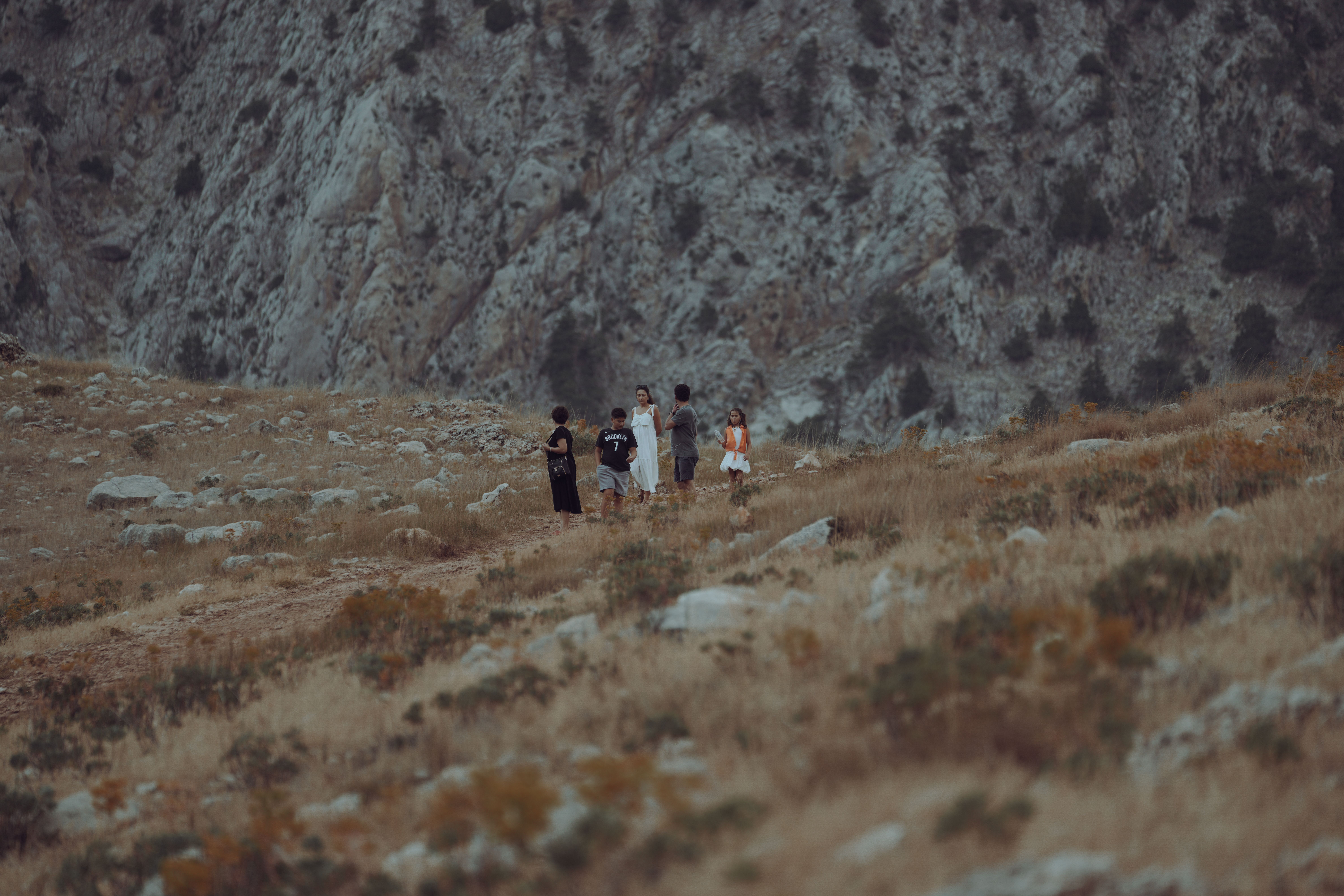
Walkers below a cliff line: the landscape rarely dates, but the rules around it do. Access arrangements, permits and closure seasons are the lines most likely to need rewriting on a page like this, which is why a dated guide is a prompt to check them again before you go.
Pages are kept current,
and corrected in public.
A travel guide is never finished. Roads are sealed, ferry and transport arrangements change, parks introduce booking systems or close tracks for a season, and a run of unusual years can make a confident seasonal sentence look silly. We would rather tell you plainly that a page can go out of date than let it read as timeless.
Region pages and dated entries carry a date. The date they were published, with the date of any revision beside it, so you can see at a glance how old the advice in front of you is. Method and index pages like this one carry no date, because they describe how we work rather than conditions on the ground.
Where nothing has changed, we say so. A dated page that still stands as first published says exactly that, rather than implying a review that never happened. Read the date as a prompt to verify anything time-sensitive before you go.
Timing-sensitive pages get another pass. Where a page turns on a season — When to Go: Seasons and Timing and the regional entries — we come back to it rather than letting it stand untouched for a year.
Rewritten when the ground changes. A new sealed section, a changed access rule or a closed track means the paragraph is replaced and the revision dated, not footnoted.
Corrected on notice. If a reader shows us we are wrong, the sentence changes. We do not leave an error standing because it reads well.
Nothing here is
for sale, including
the recommendations.
Trips and Tours is a discovery journal, not a booking agency. We do not sell trips, hold departures or take payment for travel, which is why you will not find prices, availability or departure dates anywhere on the site.
No operator, region or property pays to be written about, and no place on this site is sold as advertising dressed up as editorial. There are no commissions attached to bookings you make after reading a guide, because there is nothing here to book through.
That position has a practical consequence for the writing. We can say that a stretch of coast is best avoided in the school-holiday fortnight, that a famous drive is dull in one direction, or that a region deserves fewer days than its reputation suggests, without a commercial relationship pulling the sentence the other way. It also means our recommendations stay general: we describe how a kind of trip behaves, and leave the choice of who you travel with to you.
Where an editorial position affects readers directly — staying longer in fewer places, spending with the communities you travel through, respecting protected areas and cultural sites — we argue it openly rather than implying it. That case is set out in Travelling Responsibly, and the reasoning behind the journal itself in About Trips and Tours.
Found something wrong?
Tell us which line.
Corrections come through the same form as everything else: a distance that does not hold, an access rule that has changed, a seasonal sentence a run of odd years has made untrue. Name the guide and the sentence; it is checked against the published source before anything changes.
WHAT THE FORM CARRIES
Corrections. A line that no longer matches the road, the park notice or the published timetable.
Questions the guides leave open. A question that would help more than one reader is answered publicly in Reader Questions rather than one at a time.
Subjects and route notes. Trip Records sets out the format a route log will take once a road has been travelled end to end.
A link to where the correct information is published — a park notice, a transport agency page, a term calendar — shortens the work considerably. Contact and Enquiries covers what the form asks for.