An independent travel journal — go when the country is at its best.
Questions, corrections, story notes
Journal · Travelling alone
Nobody to ask
what you feel
like doing.
The first trip you take alone is less a test of nerve than a test of admin. Nobody else is holding half the plan, so every small decision — when to eat, when to stop walking, whether the wet afternoon is worth pushing through — lands on you, one after another, from breakfast to dark.
This entry is a working account of that: how a solo day actually paces itself, the handful of habits that take most of the friction out of it, what eating alone is genuinely like after the third night, and what to do with the flat hour that turns up somewhere around four in the afternoon. It is honest about the parts that are dull or awkward, because those are the parts nobody warns you about and they are the ones that make people book the flight home early.
IN THIS ENTRY
01 A day with nobody to negotiate with
02 Five habits that carry the trip
03 Eating alone and the quiet stretches
04 Five trades, and the bill on each
Written for a first trip taken alone in Australia — a week or two, ordinary roads and ordinary towns, no expedition and no heroics required.
PART 01
A day with nobody
to negotiate with.
Travelling with other people is a long, low-level negotiation. Where to eat, how long to stay at the lookout, who is tired and won’t say so. Remove that and the first thing you notice is not freedom — it is speed. Mornings alone run early and efficiently, because nothing slows them down. By ten o’clock you have seen the thing you came for.
The second thing you notice is that the day has no natural shape. With company, the day is broken up by other people’s needs; alone, it is one continuous stretch that you have to divide yourself. Most first-timers overfill it in response, then arrive at the fourth day flattened. The better correction is the opposite one: give each day a single anchor — one walk, one museum, one drive worth doing slowly — and let the rest be unplanned. An unplanned afternoon on your own is not wasted; it is where the trip stops being a checklist.
It also helps to know that the low point is scheduled. Late afternoon, between the day being over and dinner being reasonable, is the hour when solo travel feels least glamorous. It passes. Knowing it is coming is most of the cure.
A NOTE ON PACE
Alone, you can change everything in the time it takes to decide — and that is exactly why solo trips drift into too many stops. The freedom to move is not the same as a reason to.
Two nights per place is the smallest number that still buys you a morning without packing. Three is where a town starts to feel like somewhere you know rather than somewhere you passed.
PART 02
Five habits
that carry
the trip.
None of these are about bravery. They are the small structural choices that stop a solo day from becoming a series of unnecessary decisions made while tired.
01 · Book the first two nights, not the whole trip
Arriving somewhere new with nothing settled is the one moment where solo travel is genuinely harder than travelling in pairs. Fix the start, leave the middle open.
02 · Arrive in daylight
Every unfamiliar place is easier to read at four in the afternoon than at nine at night — the walk from the car park, the direction of the main street, which way the wind comes off the water. Build the leg to finish early rather than to cover more ground.
03 · Choose accommodation for its front desk, not its photographs
Somewhere with a person at the counter, a common room or a kitchen changes a solo trip more than the quality of the room does. It gives you somewhere to be that is neither your bed nor a restaurant.
04 · Tell one person your rough route
Not a minute-by-minute plan — the towns, the nights, the days you expect to be out of phone range. Send a short message when it changes. It costs you nothing and it removes a background hum of worry from everyone at home, including you.
05 · Keep one fixed thing in the morning
A booked walk, a ferry, an opening time. A day alone that begins with a decision often begins late; a day that begins with an appointment gets going by itself.
THE FOUR O’CLOCK HOUR
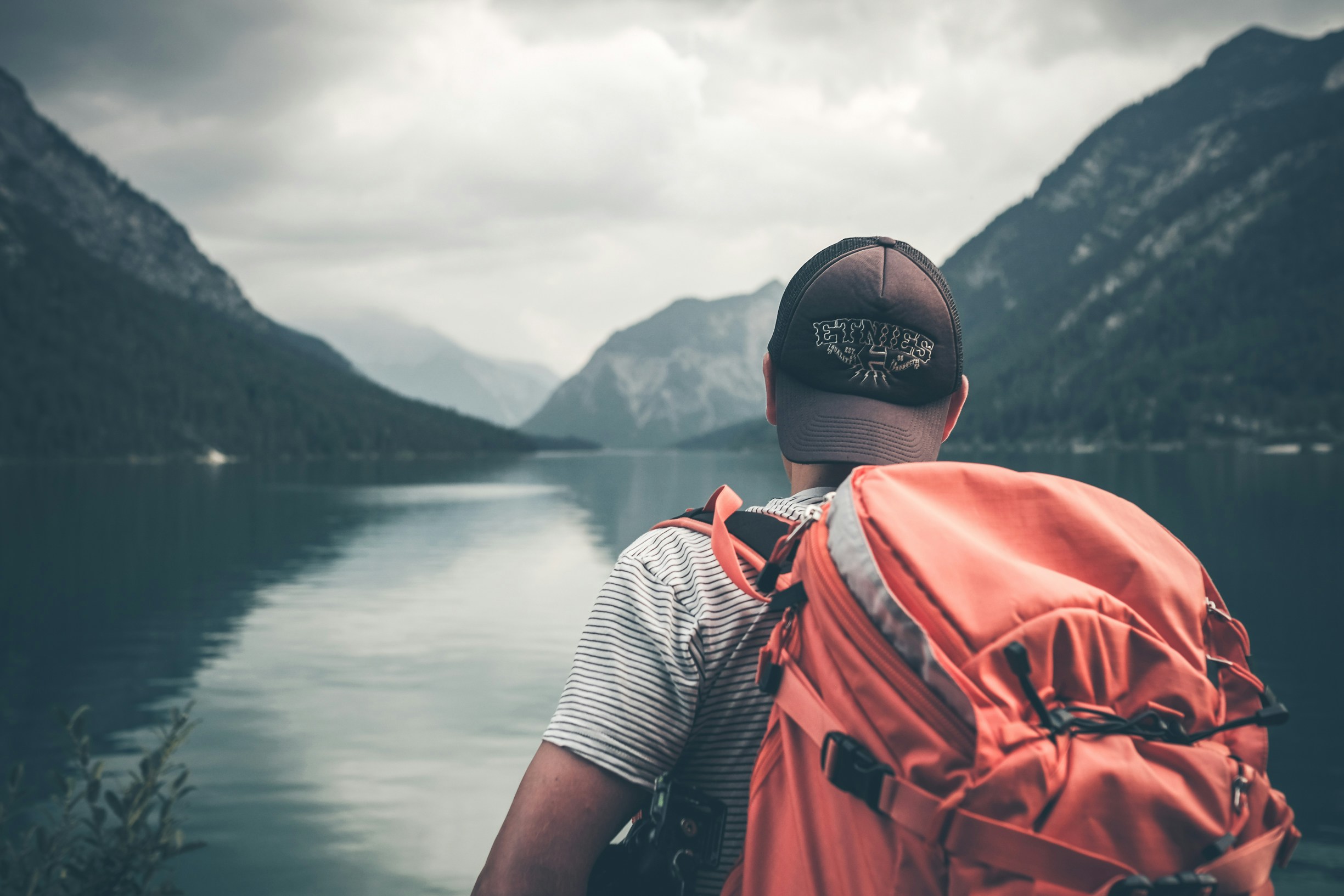
One traveller, a still lake and an afternoon with nothing in it. That is the shape of the hour between the day’s one anchor and a reasonable dinner: nothing scheduled, nobody to consult, and daylight left over. Whether it reads as the best part of the trip or the hardest usually comes down to whether you planned for it before you arrived. (Stock photograph, chosen for the hour it shows rather than for the place.)
PART 03
Eating alone, and
the quiet stretches.
Dinner is the part people dread and it is genuinely awkward once — the first night, at a table for two with one place setting, at the hour everyone else is out in pairs. After that it stops mattering, and the practical fixes are small: eat earlier than the crowd, sit at the bar or the counter where a single seat is normal, choose the noisy place over the hushed one, and take something to read so that looking at your phone isn’t the only option.
The quiet stretches are the real work. Nobody tells you that travelling alone includes hours with nothing happening and no one to say it to, and that those hours are not a failure of the trip. Give them a use — a long walk with no destination, writing the day down, a swim, a second coffee somewhere with a view of a street. Two or three days in, the same silence reads completely differently, and by the end of the week you notice you have been talking to strangers all day: the person at the counter, the couple at the lookout, the family at the next campsite. Alone is the state that makes other people approachable.
PART 04 · THE LEDGER
Five trades,
not five rules.
Read each row as one exchange rather than a verdict: the thing travelling alone hands you, and what it takes back in the same breath. Neither half cancels the other out, and knowing which trade you mind least is most of the decision.
01 · The whole day is yours
Start at five, stop at two, change the route at a roadside sign.
The bill: every part of it is your job — driving, navigating, parking, checking in, remembering the charger, with nobody to hand half of it to.
02 · You read a place at your own speed
An hour in one room of a gallery, or four minutes and out.
The bill: most of what you see you will describe later rather than share at the time.
03 · Strangers talk to you
A single traveller is approachable in a way a pair never is.
The bill: between the day ending and dinner starting there is a long hour with nobody in it.
04 · Plans change instantly
One extra night somewhere good costs one decision, not a discussion.
The bill: nothing splits. A room, a hire car and a taxi cost the same for one as for two, which is why solo budgets bend toward shared rooms, buses and longer stays — see Budgeting a Trip.
05 · You find out what you actually like
With nobody to defer to, your preferences turn out narrower and clearer than you thought.
The bill: tiredness compounds. There is no second driver, and no one to say you have had enough for one day.
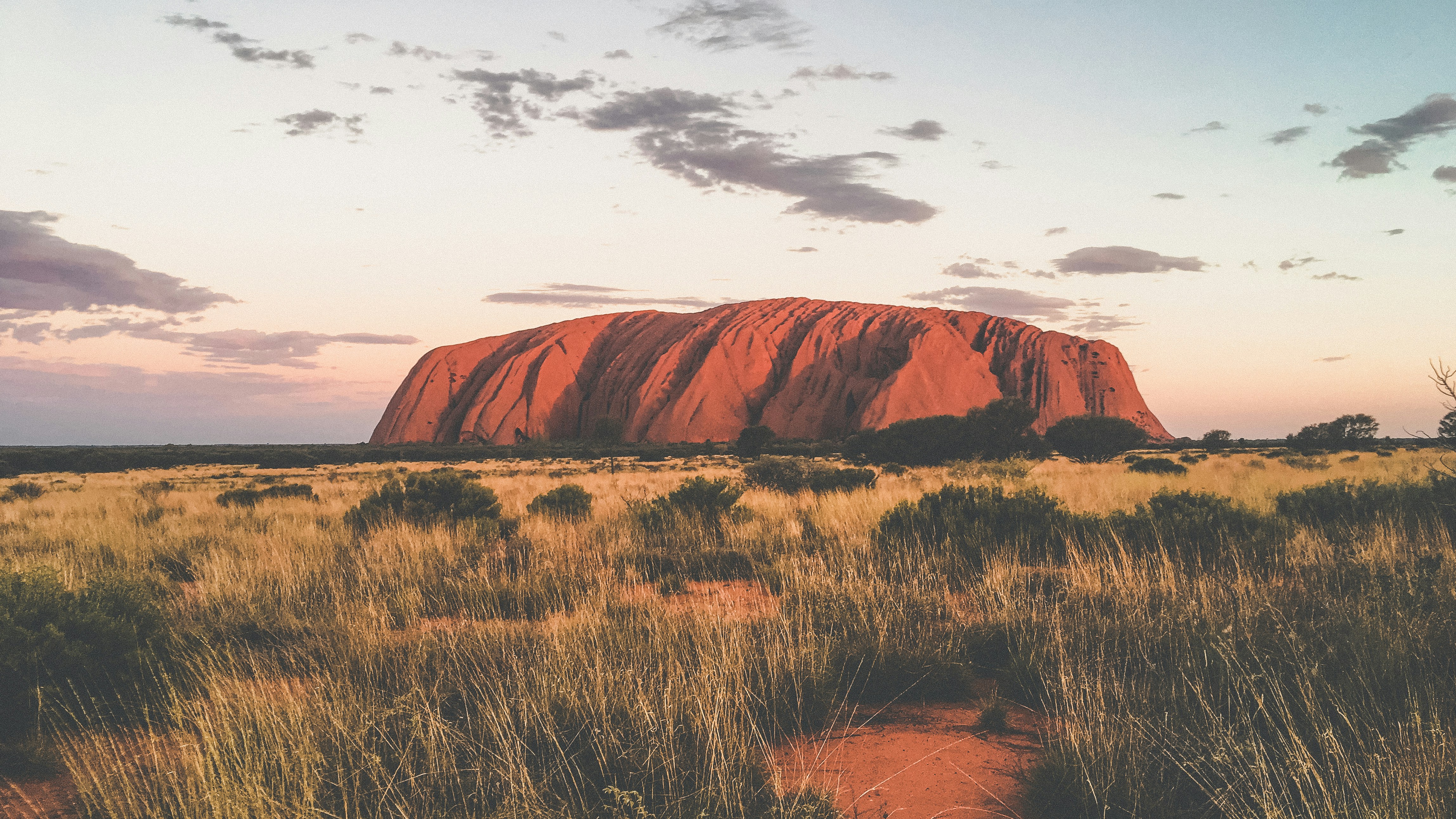
The walking track in the foreground is the easy part of a day like this. What a solo traveller has to settle beforehand sits behind the camera: the hours of road to reach the trailhead, the stretch with no reception in the middle of them, and the heat that decides how early you have to start. Stock photograph, used to show the country rather than to send you to a particular rock.
PART 05
Going further out
on your own.
A first solo trip is easiest where the country is populated: coastal towns, capital cities, a short regional loop with a fuel stop every hour. That is not timidity, it is sequencing. Remote inland and northern travel asks for spare water, real fuel range, a plan for no reception and a tolerance for long hours behind the wheel, and all of those are simpler to learn once before you also learn them alone.
If the interior is where you want to start anyway, shift the plan toward shorter legs, earlier arrivals and places where somebody knows you are coming. Read the conditions from the people whose job it is to know them — park and road authorities, local visitor centres, station and roadhouse staff — and let their advice override anything written in advance, including ours. We write about how regions behave in general; the current state of a road, a track or the weather is not something a guide published months ago can tell you.
PART 06
Where to
read next.
Two of these sit directly behind this entry. The rest are the pages a first trip alone runs into, roughly in the order it runs into them.
TELL US WHAT IT MISSED
If your own first trip alone taught you something this entry skips, or a line here reads wrong on the road, the form takes reader questions, corrections and suggestions for future entries. Guidance is all we publish — nothing on this site is sold or reserved.
THE GUIDES BEHIND THIS ENTRY
Travel Styles: Solo, Family, Group — the standing guide this entry argues from: how pacing, budget and decision-making change with who is beside you.
Trip Planning Basics — turning a rough idea into a workable outline, including how much to fix before you leave.
When to Go: Seasons and Timing — quieter windows suit a first solo trip; this sets out what you trade for them.
Cities and Short Breaks — the gentlest ground to travel alone on, and how to use a two- or three-day window well.
ELSEWHERE IN THE JOURNAL
Cutting Costs Without Cutting Days — the entry to read when nothing splits two ways.
The Journal — the rest of the short entries, arranged by subject rather than by date.