An independent travel journal — go when the country is at its best.
Questions, corrections, story notes
Chapter 05 · Inland
The interior
sets the terms.
Plan to them.
Inland Australia does not reward improvisation. The gaps between fuel, water and help are measured in hours rather than blocks, the heat keeps its own calendar, and phone coverage stops long before the scenery does.
Read this as preparation rather than persuasion: what the country asks of a vehicle, a day and a visitor, and why a week that feels slow on the coast feels about right out here.
Remoteness is a distance between services, not a mood.
On a map the Red Centre looks like a short list of names with a great deal of space between them. In practice the space is the subject. The measurement that matters is not how far apart two towns sit, but how far apart two working fuel pumps sit — and whether the second one keeps shorter hours than the first.
That one shift changes how a route is built. You stop planning to arrive and start planning to top up: fuel taken whenever it is offered rather than when it is needed, water carried rather than found, and a driving day sized to finish well before dusk, because stock and wildlife own the road at last light.
It also changes what a good day looks like. Three hundred kilometres with two long stops reads as a full day inland, and the trip improves for it. Our page on how far to drive in one day works through the arithmetic; Australian Road Trips covers how the same distances behave elsewhere in the country.
THREE HABITS THAT TRAVEL WELL
Fill when you can, not when you must.
Half a tank inland is an empty tank in planning terms.
Finish early.
The last hour of light is the one that costs people windscreens and bull bars.
Carry your own margin.
Water, shade, spare food and a spare plan, sized for a longer day than the one you intend.
Five things settled before the last town.
None of this is specialist knowledge. It is simply the list that stops a small problem from becoming a long wait in the sun.
01 · Fuel range
Know the longest gap on your route and treat it as though the far end may be closed. Roadhouse hours inland are shorter than city habits assume.
02 · Water
Carry more than the drive needs, keep it in more than one container, and drink on a schedule rather than on thirst. Dry heat hides how much you are losing.
03 · Communications
Assume no mobile signal between settlements. Download maps offline before you leave coverage, and consider a satellite messenger or beacon for unsealed and remote routes.
04 · Tyres and recovery
Pressures set for the surface, a spare you can actually change, and the tools to change it. Heat and corrugations find weak tyres faster than anything else on the trip.
05 · Someone who knows the plan
Leave your intended route and expected arrival with a person who will notice if it passes. Then stay with the vehicle if anything goes wrong — it is shade, shelter and the largest thing to see from the air.
Dirt changes the arithmetic, not the destination.
A great deal of the interior’s road network looks like the photograph below: a broad graded surface with no seal and no edge line, running straight at the horizon through low scrub. It reads fast and drives slow — a road like this will halve your average speed and double your fatigue compared with the bitumen behind you. Plan the surface, not the line.
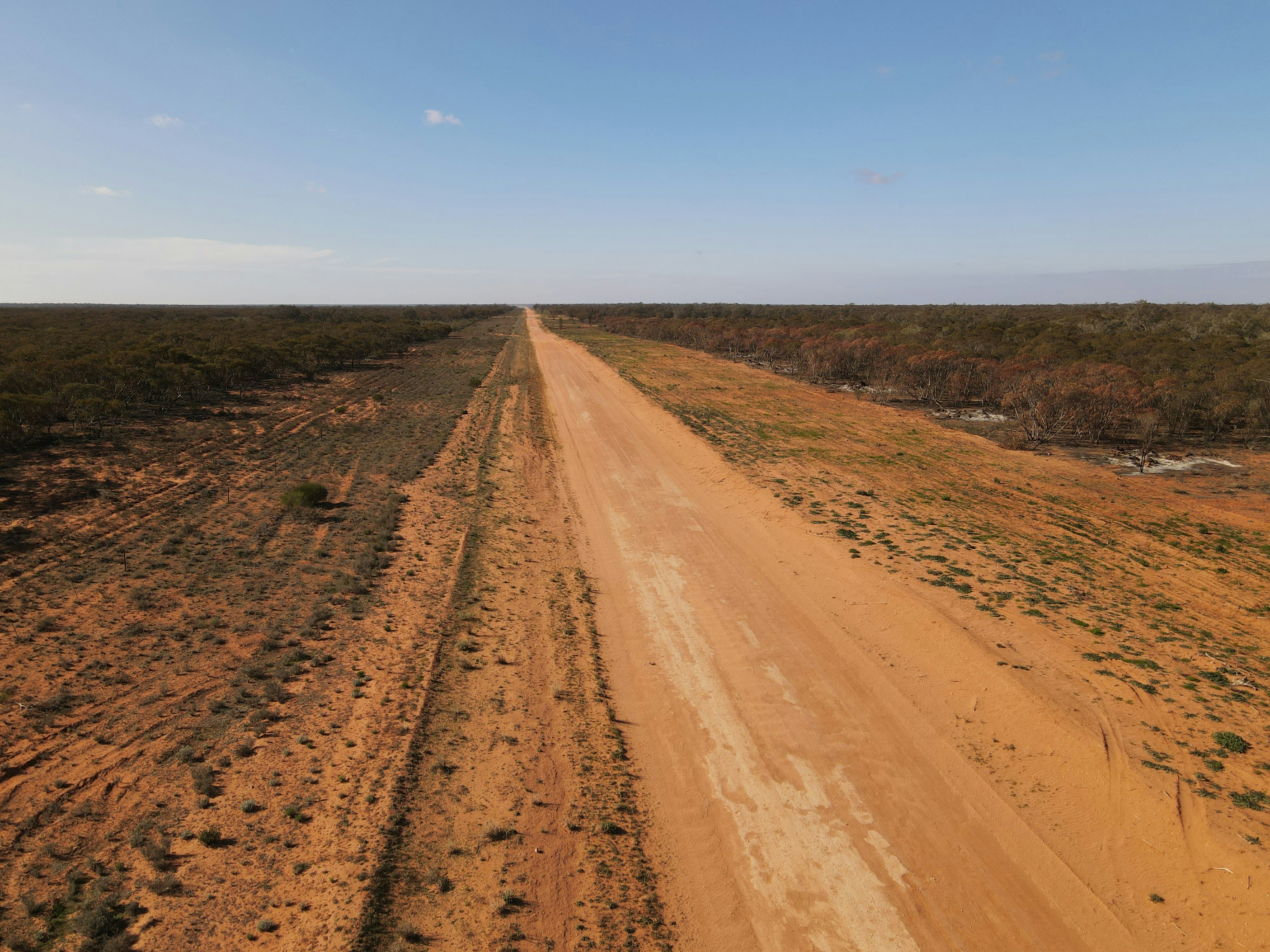
Above: a graded orange road running straight at the horizon through sparse scrub — no seal, no edge line, and nothing in the surface to tell you what speed it will tolerate.
Corrugations. They shake loose everything unsecured, including roof loads and confidence. Slower is safer than the mythical speed at which they smooth out.
Dust and oncoming traffic. A road train’s dust removes your road entirely. Slow, move left, wait for the air to clear before committing.
Rain and closures. Unsealed roads shut quickly after rain and reopen on their own schedule. Check current road conditions the morning you drive, and accept a closure rather than testing it.
Hire agreements often exclude unsealed roads or specific tracks — read yours before you plan a route that depends on one.
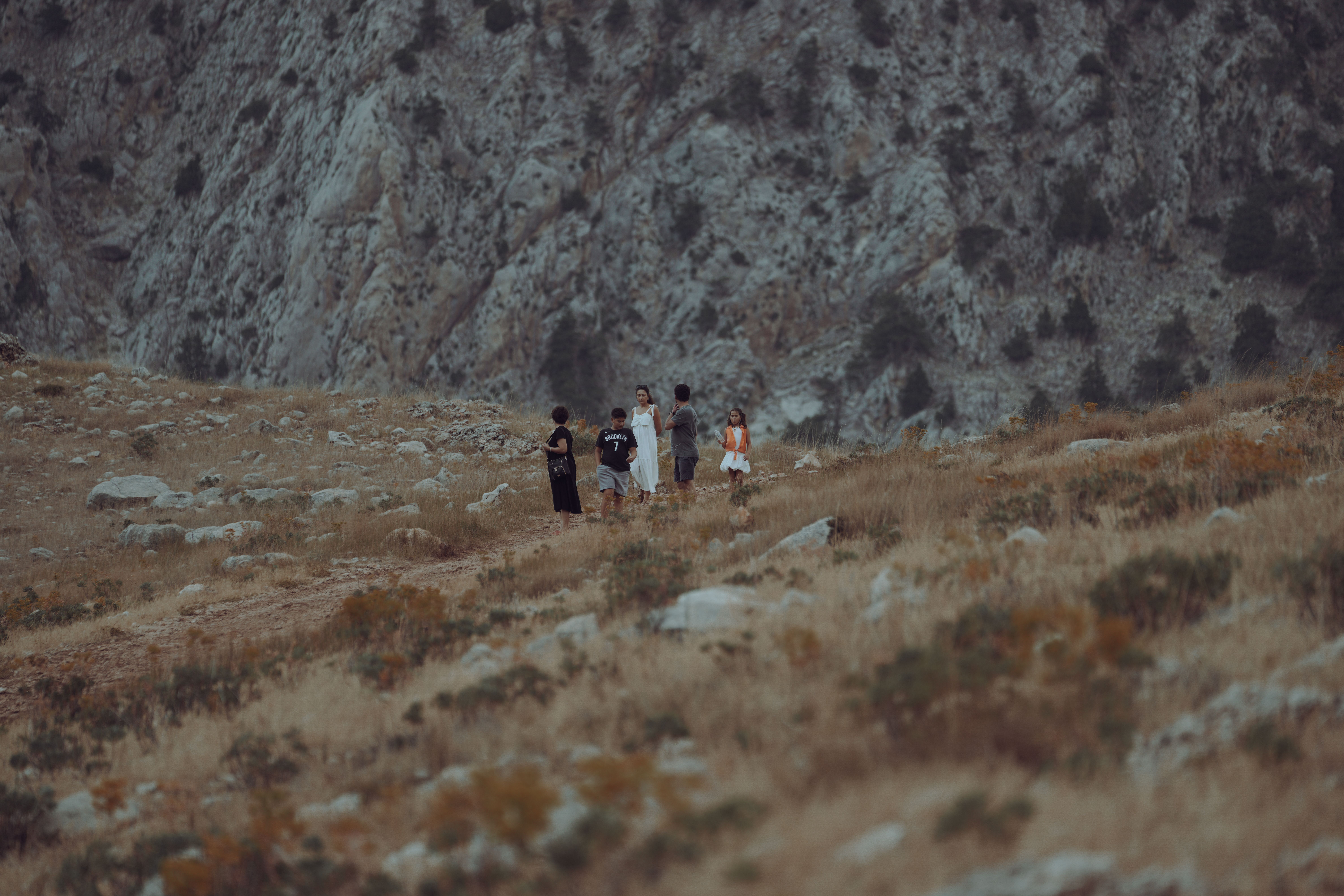
Much of the interior is someone's home and always has been.
Travelling well inland means treating access as a courtesy extended to you, not a right you arrive with. The walkers in the photograph are crossing the grassland at the foot of the cliff rather than going up it, which is most of this section in one image: what is asked of visitors is usually simple, clearly signed and worth honouring without negotiation.
Permits. Some land requires a permit to enter or transit — arrange it before you leave, not at the boundary.
Signs and closures. Signed no-photography areas and closed sites are asked for reasons that do not require your agreement.
Climbs. Some formations are not to be climbed. Walk the base instead; it is usually the better experience anyway.
Where the money lands. Buy locally, use Aboriginal-owned tours and art centres, and let guides set what is shared.
Camps and water. Camp only where camping is permitted, carry out everything, and leave water sources undisturbed.
The interior has a walking season and a driving season.
Summer inland is not a harder version of summer elsewhere; it is a different activity. Heat decides what a day can contain, so timing does more work here than in any other region we cover — and the four notes below are the whole argument.
Read against the seasonal chapter rather than against a forecast: inland timing is decided months earlier than a weather app can help with.
Cool months
The walking season. Clear days, and desert nights cold enough to need real bedding rather than optimism.
Hot months
Long walks and gorge tracks are commonly closed or discouraged once temperatures climb. The driving season takes over from the walking one.
The shape of a day
Start at first light whatever the month. Treat the middle of the day as driving, shade or rest, and be off the road well before dusk.
Rain, and holidays
Rain is rare but decisive: it closes roads far faster than it falls. School holiday weeks fill the small number of beds and campsites that exist out here.
Four questions this chapter settles.
More in Reader Questions, and the practical side of getting ready in Packing and Preparation.
Do I need a four-wheel drive?
Not for the sealed highways and the best-known parks, which a well-prepared two-wheel drive handles comfortably. The moment your route includes a named track, sand or a river crossing, the vehicle, the tyres and the driver all need to be up to it — and honesty about that is cheaper than recovery.
How long is long enough?
Longer than the map suggests. The interior is built from few places and large gaps, so a trip that adds destinations usually loses the thing it came for. Two bases held properly beat five passed through, and the extra nights cost less than the extra fuel.
Is it sensible to travel alone?
On main routes, yes, with the same margins doubled: more water, shorter days, a filed plan and a way to call for help without a phone tower. Solo pacing and its trade-offs are covered in Travel Styles: Solo, Family, Group.
Can it be done on a tight budget?
It can, but the shape of the spending is unusual: fuel and distance dominate, while accommodation choices are limited rather than expensive. Staying longer in fewer places is the saving that works out here — see Budgeting a Trip.
Roads close, and
this page ages
with them.
Permits get added, roadhouse hours shorten, a closed track reopens on a schedule nobody publishes. If a sentence on this page no longer matches what you found past the last town, name it and say when you drove it — corrections to the interior pages are read before anything else.
REGIONS THIS CHAPTER CROSSES
Travelling in the Northern Territory
Two calendars inside one border: the Top End wet, and cold Red Centre nights.
Travelling in South Australia
Where the vineyards stop and the ranges take over the daily driving target.
Travelling in Western Australia
The longest gaps between services of anywhere on the board.
TOPICS IT LEANS ON
Trip Planning Basics
Size the window before the route; inland punishes a full itinerary.
Travelling Responsibly
Staying longer, spending closer, and leaving water sources undisturbed.
Coast and Reef
The half most inland trips are paired with, at the opposite pace.